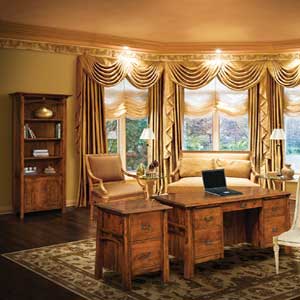

Introduction: Choosing between an Amish executive desk and a modern office desk significantly impacts your workspace functionality, comfort, and longevity. This comprehensive comparison examines construction quality, materials, durability, aesthetics, and value to help you make an informed decision for your home office or professional workspace.
Construction and Materials
Amish Executive Desks:
Solid Hardwood Construction:
- Materials: 100% solid oak, cherry, maple, or walnut throughout
- Frame: Solid wood frame with traditional joinery
- Desktop: Thick solid wood (1-1.5" typical)
- Drawers: Solid wood with dovetail joints
- No Composites: Never particle board, MDF, or veneer
Traditional Joinery:
- Mortise-and-tenon joints for frame
- Dovetail drawer construction
- Dowel reinforcement
- Minimal hardware reliance
- Hand-fitted components
Modern Office Desks:
Mixed Materials:
- Desktop: Often particle board with veneer or laminate
- Frame: Metal, engineered wood, or combination
- Drawers: Particle board or thin plywood
- Finish: Laminate, melamine, or thin veneer
- Cost-Driven: Materials selected for affordability
Assembly Methods:
- Cam locks and connector bolts
- Staples and glue
- Minimal traditional joinery
- Hardware-dependent construction
- Often requires assembly
Durability and Longevity
Amish Executive Desks:
Expected Lifespan:
- Frame: 50-100+ years
- Desktop: Lifetime with proper care
- Drawers: 30-50+ years of daily use
- Finish: Can be refinished multiple times
- Overall: Generational heirloom quality
Durability Features:
- Solid wood resists dents and damage
- Traditional joinery strengthens over time
- Can be repaired and refinished
- Withstands heavy daily use
- No delamination or peeling
Modern Office Desks:
Expected Lifespan:
- Budget Models: 3-5 years
- Mid-Range: 5-10 years
- High-End: 10-15 years
- Finish: Cannot be refinished
- Overall: Disposable to semi-permanent
Common Issues:
- Particle board swells with moisture
- Veneer chips and peels
- Hardware loosens over time
- Drawers sag or break
- Not repairable when damaged
Functionality and Features
Amish Executive Desks:
Standard Features:
- Drawers: Deep, smooth-gliding with dovetail construction
- File Storage: Full-depth file drawers
- Work Surface: Spacious, solid wood desktop
- Cable Management: Available on many models
- Keyboard Tray: Optional on some designs
Customization Options:
- Size adjustments to fit your space
- Wood species selection
- Finish color choices
- Hardware selection
- Drawer configuration
- Add-ons (hutches, returns, credenzas)
Modern Office Desks:
Standard Features:
- Drawers: Variable quality, often shallow
- Cable Management: Built-in grommets common
- Adjustability: Some offer height adjustment
- Tech Integration: USB ports, power outlets
- Modular Options: Mix-and-match components
Limitations:
- Fixed sizes (no customization)
- Limited finish options
- Shallow drawer depth
- Weight capacity concerns
- Assembly required
Aesthetic and Style
Amish Executive Desks:
Design Characteristics:
- Traditional Elegance: Classic, timeless designs
- Natural Beauty: Showcases wood grain
- Substantial Presence: Commanding, professional appearance
- Handcrafted Details: Visible quality craftsmanship
- Warm Aesthetic: Rich wood tones
Style Options:
- Mission/Craftsman style
- Traditional executive
- Transitional designs
- Shaker simplicity
- Custom designs
Modern Office Desks:
Design Characteristics:
- Contemporary Lines: Clean, minimalist
- Industrial Options: Metal and wood combinations
- Varied Finishes: White, black, gray, wood-look
- Compact Designs: Space-efficient
- Tech-Forward: Modern functionality
Style Limitations:
- Trends date quickly
- Laminate looks artificial
- Less substantial appearance
- Generic, mass-produced look
Price Comparison
Amish Executive Desks:
Price Range:
- Standard Desk: $1,200-$2,500
- Large Executive: $2,500-$4,000
- With Hutch/Return: $3,000-$6,000+
- Custom Designs: $4,000-$8,000+
Cost Per Year:
- $2,000 desk / 50 years = $40/year
- One-time investment
- No replacement costs
- Retains resale value
Modern Office Desks:
Price Range:
- Budget: $200-$500
- Mid-Range: $500-$1,200
- High-End: $1,200-$3,000
- Designer: $3,000-$10,000+
Cost Per Year:
- $600 desk / 7 years = $86/year
- Replacement every 5-10 years
- 3-5 purchases over 50 years
- Total: $1,800-$3,000+
Workspace Ergonomics
Amish Executive Desks:
Ergonomic Considerations:
- Standard Height: 29-30" (industry standard)
- Knee Clearance: Generous space under desk
- Desktop Depth: 24-30" provides ample workspace
- Solid Surface: Stable for writing and computer work
- Custom Options: Can adjust height if needed
Comfort Features:
- Smooth, finished edges
- Substantial leg room
- No sharp corners
- Stable, wobble-free surface
Modern Office Desks:
Ergonomic Options:
- Adjustable Height: Some models offer sit-stand capability
- Keyboard Trays: More commonly included
- Monitor Arms: Compatible mounting
- Cable Management: Better tech integration
Limitations:
- Shallow desks limit workspace
- Lightweight construction can wobble
- Fixed heights on most models
- Less stable for heavy equipment
Environmental Impact
Amish Executive Desks:
Sustainability:
- Domestic Hardwoods: Sustainably harvested American forests
- Longevity: One desk lasts 50-100+ years
- No Landfill: Passed down through generations
- Minimal Waste: Careful craftsmanship
- Local Production: Reduced transportation emissions
- Natural Materials: No toxic off-gassing
Modern Office Desks:
Environmental Concerns:
- Particle Board: Contains formaldehyde and adhesives
- Short Lifespan: 3-5 replacements over 50 years
- Landfill Waste: Not recyclable or biodegradable
- Overseas Shipping: High carbon footprint
- Off-Gassing: VOCs from finishes and adhesives
Maintenance and Care
Amish Executive Desks:
Regular Care:
- Dust weekly with soft cloth
- Use coasters and desk pads
- Clean with wood-appropriate products
- Polish 2-4 times per year
- Address scratches promptly
Long-Term Maintenance:
- Can be refinished when needed
- Scratches can be repaired
- Hardware can be tightened or replaced
- Professional restoration available
- Maintains appearance for decades
Modern Office Desks:
Regular Care:
- Wipe with damp cloth
- Avoid excessive moisture
- Use desk pads to prevent damage
- Tighten hardware periodically
Limitations:
- Cannot be refinished
- Chips and scratches permanent
- Water damage irreversible
- Veneer peeling cannot be repaired
- Replacement often only option
Best Use Cases
Choose Amish Executive Desk If:
- You work from home permanently
- You value quality and craftsmanship
- You want furniture that lasts generations
- You prefer traditional or transitional style
- You have a dedicated home office
- You want customization options
- You support American manufacturing
- You calculate long-term value
Choose Modern Office Desk If:
- You need immediate, budget-friendly solution
- You prefer contemporary/minimalist aesthetic
- You move frequently
- You need specific tech features
- You want adjustable height capability
- You have temporary workspace needs
- You prefer lighter-weight furniture
Conclusion: Investment vs. Expense
Amish executive desks represent an investment in quality, durability, and timeless style that serves you for decades. While modern office desks offer lower initial costs and contemporary features, they require replacement every 5-10 years. For permanent home offices and those valuing craftsmanship, Amish desks provide superior long-term value, comfort, and satisfaction. For temporary needs or specific modern features, contemporary desks serve adequately. Your choice depends on priorities: lasting quality and tradition versus immediate affordability and modern aesthetics.
Frequently Asked Questions
What is the difference between Amish and modern office desks?
Amish desks use 100% solid hardwood with traditional joinery, lasting 50-100+ years. Modern desks typically use particle board with veneer, lasting 5-10 years. Amish desks offer superior durability, customization, and timeless style, while modern desks provide lower initial cost and contemporary features like height adjustment.
Are Amish executive desks worth the higher price?
Yes, for long-term value. A $2,000 Amish desk lasting 50 years costs $40/year, while a $600 modern desk lasting 7 years costs $86/year and requires 3-5 replacements ($1,800-3,000 total over 50 years). Amish desks offer better quality, can be refinished, and become heirlooms.
Can Amish desks accommodate modern technology?
Yes, many Amish desks include cable management grommets, keyboard trays, and can be customized with tech features. While they may not have built-in USB ports like some modern desks, their solid construction provides stable surfaces for monitors and equipment, and customization allows for specific tech needs.
How long do Amish executive desks last compared to modern desks?
Amish executive desks last 50-100+ years with proper care due to solid hardwood construction and traditional joinery. Modern office desks last 5-10 years on average (budget models 3-5 years) before particle board deteriorates, veneer peels, or hardware fails. Amish desks can be refinished; modern desks cannot.


